

Learn what approvals you need to build a pool or spa, how to make sure your safety barriers meet the rules, how to maintain it safely and what public pool owners must do to meet health and safety standards.
Swimming pool fencing and safety requirements
All pools and spas must be enclosed by safety barriers that meet the Australian Standard AS 1926.1 – 2012, to prevent unsupervised access by young children.
This includes in-ground, above-ground, inflatable and portable pools that:
- Hold more than 300mm of water
- Have a filtration system
- Is used for swimming, wading or paddling
You will also require development approval. This applies to in-ground, above-ground, inflatable and portable pools to:
- Installing or upgrading a pool barrier (including boundary fencing)
- Removing an existing pool or spa
Internal pool fencing must:
- Be a permanent, effective barrier to entry
- Be at least 1.2 metres high
- Include a continuous non-climbable zone (NCZ) of at least 900mm on the barrier’s vertical face
- Not include any footholds or handholds that allow climbing

Setback from a Barrier:
- Have a clear space of 500mm from climbable objects (like steps, planter boxes or retaining walls), while still maintaining the 900mm NCZ. (The 500mm setback helps protect the 900mm NCZ from being compromised.)

Boundary fences acting as a pool barrier must:
- Must be at least 1.8 metres high (measured from the pool side)
- Must include a non-climbable zone on the pool side of the fence
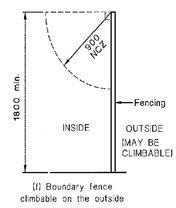
Gates into the pool area must:
- Swing outward, away from the pool
- Self-close and self-latch from any position
- Have a latch at least 1.5m above ground level — or shielded if lower as per AS 1926.1
Windows opening directly into the pool areas:
If any part of the window opens into the pool area and is under 1.8 metres above ground:
- It must be restricted to open no more than 100mm or
- Be fitted with fixed security bars or a fixed screen with openings no larger than 100mm
Doors:
- Doors from the house directly into the pool area are not permitted under current safety standards.
All pools and spas must comply with AS1926.3, which aims to reduce the risk of suction-related injuries.
You must have:
- Two suction points at least 600mm apart or
- A compliant skimmer box with a child-resistant lid
A durable CPR and First Aid sign must also be attached to the pool barrier or displayed nearby in a visible location.
If your permanent fence isn’t in place when the pool is filled, a temporary fence must be installed. This is common for fibreglass pools, which must be filled right after installation.
- Temporary fencing is valid for up to 2 months
- After that, it’s no longer a legal barrier
Refer to the Swimming Pool Safety Regulations 2019 for full details.
Pools approved before 1 July 1993
If you’re selling the property, you must upgrade the barrier to meet AS1926.1 – 2012 before settlement.
Pools approved 1 July 1993 – 30 April 2013
Your barrier must comply with the safety standards that were in place at the time of approval, and be kept in good condition.
Once your development application is approved, you must:
- Notify Council at key stages via the PlanSA portal, including:
- Start of building works
- Completion of pool fencing and CPR signage
- Final completion of the build
Check your Decision Notification Form for full details.
Need help?
Pool safety rules can be detailed and complex. This page is a guide only.
For tailored advice, contact our Duty Building Surveyor on 1300 133 466.
You can also refer to the Planning, Development and Infrastructure (Swimming Pool Safety) Regulations 2019 for detailed legislative information.
How to maintain your swimming pool
Poorly maintained swimming pools can create serious health risks for users. Humans, animals and the environment can contaminate pools with infectious organisms. In most cases these organisms cause mild illness, but some infections can be serious or potentially fatal.
In the lead up to summer, it’s important you keep your pool water sparkling. Testing and maintaining your pool should be done regularly during swimming season. Swimmers introduce microorganisms, body secretion, sunscreen lotions and other pollutants to the water; it’s a health and safety hazard. You need to keep your pool water quality high to prevent ear, eye, skin and intestinal infections.
Pool filtration systems collect water and capture and contain pollutants in the filter. Your pool needs regular backwashing to clear out these contaminants to work properly.
Swimming pool backwash water must not be discharged to or allowed to run-off into roadways, gutters, creeks, rivers, lakes, coastal waters or neighbouring properties.
Backwash from swimming pools must be directed to the sewer. Swimming pools should be permanently connected to the sewer at the time of installation or construction, and with approval from SA Water. Don’t let pool water run into septic tanks or other waste water disposal systems; use the water on grass or garden areas or stone-filled trench areas.
Don’t forget: If you have a salt chlorinated pool, you need to have salt tolerant plants and occasionally water with clean, good quality water.
For more information, give the Environmental Health Team a call on 1300 133 466 or visit the EPA website.
For tips on looking after your pool at home visit SA Health.
Do you own a public swimming pool?
What public pool owners need to know
Under the General Regulations of the South Australia Public Health Act, 2011, Environmental Health Officers have the responsibility and authority to inspect public swimming pools, spa pools and water slides.
Questions? Call 1300 133 466
Public pools:
- Can be used by members of the public if they pay a fee
Can be used by people staying at hotels, motels, guest houses, camping or caravan grounds, or any other temporary accommodation - Can be used by people who live or work in, or attend the pool’s premises, unless the pool is only for residents or guests of a private residence (like flats or units with a shared swimming pool, and schools)
- They’ll check if the pool is fitted with automatic equipment that continuously checks and controls the disinfectant in the water, and keeps the water’s pH level at the required standards.
- They’ll check that the levels of disinfectant (eg Chlorine), pH and alkalinity are sufficient.
- They’ll keep a log book for test results and readings.
- They’ll make sure all equipment (like filters) are clean and functional.
- They’ll note how clean the pool is, its structure and surroundings (like the presence of leaves and algae, broken tiles, rusty ladders, etc).
If you have a question that we haven’t covered, give the Environmental Health Team a call on 1300 133 466